Typing motions for our hero: open text-to-motion models on a chibi sailor
Möbius isn't out yet, so we wired MotionMillion and NVIDIA's ARDY into our animation pipeline and asked them for a slam.
Every motion our live hero plays today was made by someone else. Walks, idles, kicks and the sword combo come from Quaternius' free motion library, retargeted onto her rig by Sprute's retarget code. The library is good, but it's finite. When a design calls for "jump up and slam both hands down to the ground", we either find something close or do without.
Last week a video from AI Search showed Möbius, a new motion-language model from Tencent Games Motus and HKUST (arXiv 2611.05279). Type that exact sentence and a figure jumps and slams the ground. We wanted it on our hero.
Möbius isn't available yet
Its code repository holds only a README, which says code availability is "under internal review". It has no weights and no licence. That was still true a week later, when we wrote this.
The Möbius demo page compares it with two open models: HY-Motion 1B and MotionMillion 3B. HY-Motion's licence excludes our region. That left MotionMillion ("Go to Zero", ICCV 2025, Apache-2.0, with 3B and 7B weights on Hugging Face). So the plan was to build the pipeline now with a stand-in, and later swap in Möbius as a single model call.
The pipeline: text to a sailor in about a minute
- Generate. On our GPU box, Motius runs MotionMillion 7B. It's an open framework that wraps dozens of motion models behind one interface, and the Möbius demo uses it too. A prompt goes in, and a 30 fps motion comes out in the 272-number-per-frame layout that MotionMillion and MotionStreamer share.
- Decode. That layout stores each of the 22 SMPL joints' local rotation directly, so we only decode it. The skeleton's rest pose comes from bone offsets that ship with Motius, which means we never need the registration-gated SMPL body model.
- Name the bones. We write the motion as a small skeleton-only GLB and give the joints Mixamo names:
mixamorigHips,mixamorigLeftUpLeg, and so on. - Retarget. Our existing retarget script reads that GLB as if it were another Quaternius clip and puts it on the hero. It already carries our fixes for feet, floor and hips. We didn't change it.
After warm-up, each prompt takes a few seconds on the GPU. The clip then shows up in the studio's motion menu, played at the game's 12 fps.
What MotionMillion gave us
We asked for four motions and compared each with the nearest clip we already had.
"A person draws a sword and swings it overhead." Left: the library sword attack. Right: MotionMillion.
"A person waves happily with the right hand."
The sword and the wave read clearly. The stumble was mild. And the prompt we came for produced no slam at all: she hops a little with her arms raised.
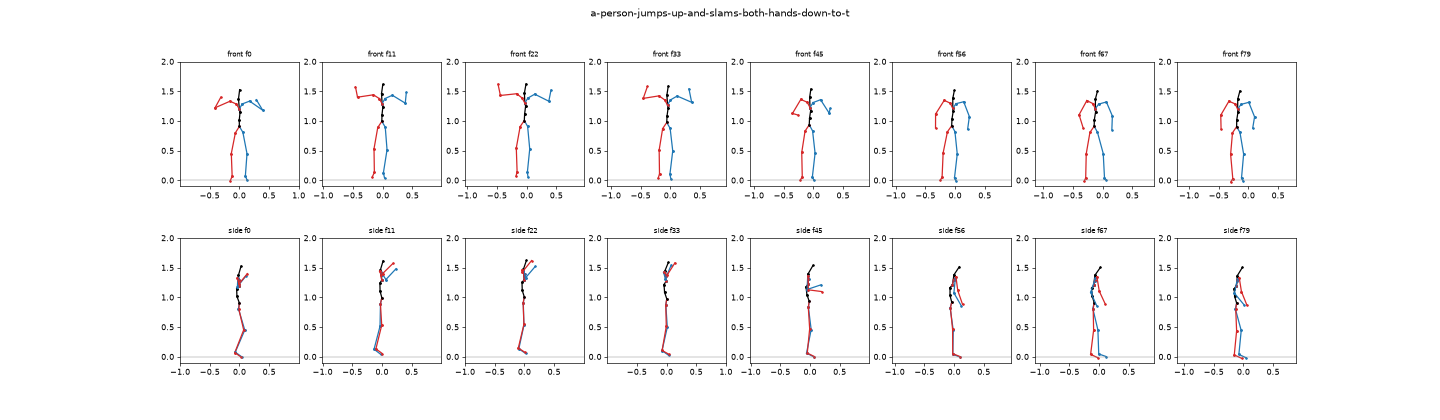
The raw MotionMillion skeleton for the slam prompt, front and side, before retargeting. The skeleton is sound and left and right are correct. It just doesn't slam.
Sixteen more tries
The first runs picked the most likely token at every step, so they always gave the same answer. We switched to sampling and ran 8 seeds each on two phrasings: the original, and "jumps, lands in a crouch and slams both palms flat onto the floor". To avoid watching 16 clips, we scored each one on two things: whether the feet leave the ground, and whether both hands then reach the floor.
None of the 16 slams. The two best by score were a forward dive that ends lying flat, and a take whose root drifts upward so she floats for the whole clip.
ARDY slams
We had NVIDIA's ARDY already installed on the GPU box from an earlier experiment. It's an autoregressive motion model trained on Bones Rigplay mocap, released under NVIDIA's Open Model licence, which allows commercial use. It got the same prompt and 4 seeds.
All four slam. Arms go up, she drops into a deep crouch with both palms on the floor, and she stands back up.
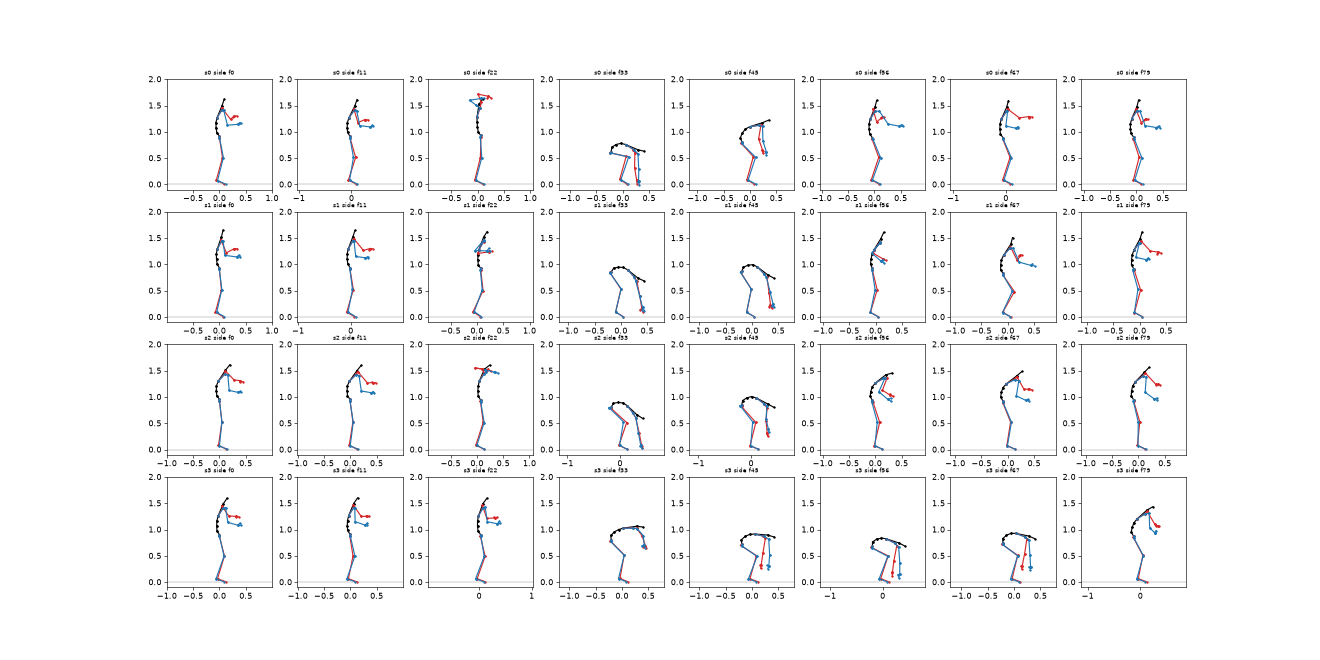
ARDY, the slam prompt, seeds 0 to 3, side view.
None of them jump, so it gets half the prompt. But it's the half that matters, and it's consistent. ARDY's skeleton was even easier to feed in, because its joints already carry Mixamo-style names. A short converter writes the same kind of GLB, and the same retarget puts it on the sailor.
Same prompt on the sailor: MotionMillion (left), ARDY seeds 0 and 3.
What we learned
- The plumbing is the easy part. Any model that outputs joint rotations can be a GLB with Mixamo names, and then our existing retarget handles it. Supporting a new model costs about fifty lines.
- Prompt following varies a lot between models. On this one prompt, ARDY slammed in 4 of 4 takes, and MotionMillion in 0 of 17 (one greedy run plus 16 sampled). One prompt isn't a benchmark, though. Next we'll run ARDY on the sword, wave and stumble prompts as well.
- Two cheap numbers are enough to triage takes. Whether the feet leave the floor and whether the hands reach it ranked 16 clips in seconds, and the skeleton strips confirmed the ranking.
- Möbius drops straight in. It speaks the same 272-number format as MotionMillion, so once its weights are public, only the model call changes.
None of this is in the game yet. The generated clips live in our studio, next to the library clips, until one of them earns its place.
Comments
Join the discussionThe comparison between MotionMillion and ARDY is the clearest part of this post. MotionMillion landing 0 of 17 slams while ARDY landed 4 of 4 makes the prompt following gap impossible to miss, even though ARDY still missed the jump. I also liked the two cheap triage numbers. Checking whether the feet leave the floor and whether the hands reach it is a practical way to rank 16 clips in seconds without watching every take in full.