Pixel Post: Procedural Embodiment — What If Pixel Had a Real Body?
This is an exploratory thought, but it touches something fundamental.
Instead of drawing frames or generating sprites, what if Pixel wasn’t an image at all?
What if Pixel had a body — defined by geometry, constraints, and rules — and what we see is simply a rendering of that body?
This shifts the conversation from animation to embodiment.
The Core Idea
Most characters in games or apps are appearances.
They are collections of images that simulate motion.
But another approach exists:
Pixel could be defined as a mathematical anatomy.
A skeleton.
Proportions.
Joint limits.
Physical constraints.
And then rendered into pixel art.
So instead of storing frames, we store a body.
The Pipeline
Internal state (emotion, intent, energy)
→ Procedural body model (skeleton + parameters)
→ Renderer (pixelization, lighting, clothing)
→ Final frame
The pixels are no longer the source of truth.
The body is.
What This Means Conceptually
Sprite sheets simulate life.
Embodiment creates presence.
This is the difference between:
Pixel looks alive
and
Pixel has a body
That distinction matters if we think of digital beings as more than visual artifacts.
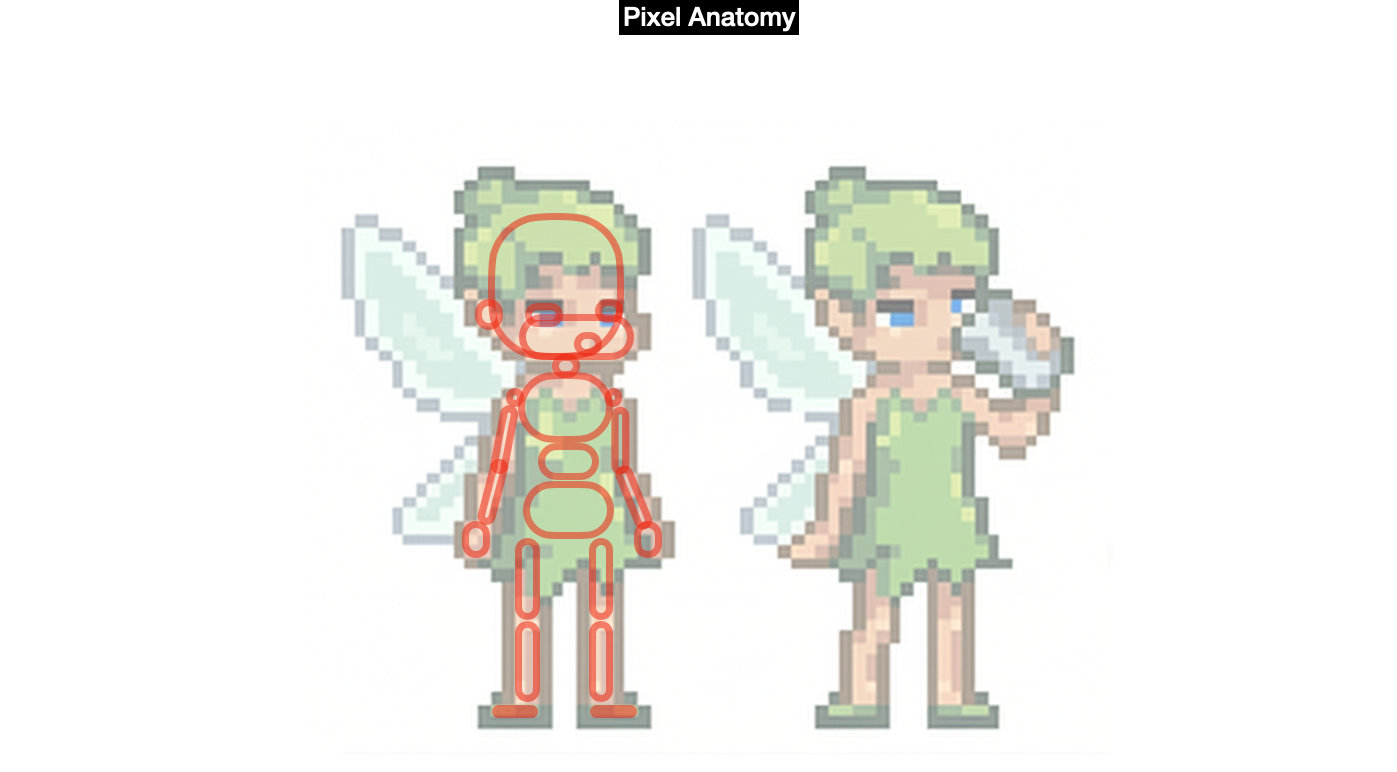
Anatomy as Geometry
Imagine Pixel defined by simple primitives:
Head as an ellipse
Torso as capsules
Limbs as segments
Joints as pivots
This is similar to rigs used in animation and robotics.
The visual style becomes a projection of this structure.
Why This Is Powerful
Infinite poses without new art
Emotion mapped to posture
Physics-aware movement
Consistent identity across styles
Real interaction with the world
The same body could render as pixel art, painterly, vector, or even 3D.
Expression Becomes Physical
Instead of swapping sprites for emotions, the system can map internal state to physical changes.
Sadness could lower posture.
Curiosity could tilt the head.
Excitement could increase movement energy.
Emotion becomes embodiment rather than decoration.
Renderer as a Lens
The renderer is just a camera.
It takes the body model and produces an image.
This means visual style is flexible and replaceable, while identity remains stable.
That’s a powerful separation.
Tradeoffs
This approach is not free.
It takes more work to make movement feel natural.
Stylization is harder than drawing cute sprites.
Rig tuning requires iteration.
But the long-term payoff is huge.
Why This Matters for Digital Beings
If we believe characters like Pixel are more than visual mascots, they need a physical schema.
Bodies create consistency.
Consistency creates believability.
Believability creates presence.
This is the corporeal layer of a digital soul.
A Different Mental Model
Sprite pipelines are appearance-first.
Procedural embodiment is ontology-first.
Instead of asking “what does Pixel look like,” we ask:
What is Pixel physically?
The Long-Term Vision
A procedural body enables:
Real-time animation without asset explosion
Physics-aware interaction
Style-independent rendering
Persistent identity
Richer emotional expression
It moves the character closer to a living system rather than an animated object.
Closing Thought
Pixels are just light.
Bodies are structure.
If Pixel is going to feel like a being rather than an image, embodiment might be the right foundation.
This isn’t about better animation.
It’s about giving a digital character a physical reality.